Showing posts with label Dr. Mamata Rathi. Show all posts

Friday, June 17, 2022

Marginal Costing : Concept, Definition, Features, Advantages, Limitations

Marginal Costing


Marginal Costing: Concept


Marginal costing is a method of costing that is concerned with changes in costs resulting from changes in the volume or range of output and sales.

An increase or decrease in total costs that is caused by an increase or decrease in the volume of production and sales is known as marginal cost, differential cost, or incremental cost.


Thus, marginal costs relate to future costs and can be determined by subtracting the total at one level of output or sale from that at another level.


It should be noted that marginal costs refer to the increase or decrease in costs on account of the block of units produced or sold. The marginal costs per unit remain the same.


Marginal costing is a method of costing that is concerned with changes in costs resulting from changes in the volume or range of output and sales.

An increase or decrease in total costs that is caused by an increase or decrease in the volume of production and sales is known as marginal cost, differential cost, or incremental cost.


Thus, marginal costs relate to future costs and can be determined by subtracting the total at one level of output or sale from that at another level.


It should be noted that marginal costs refer to the increase or decrease in costs on account of the block of units produced or sold. The marginal costs per unit remain the same.


Definitions : 

D. Joseph: “Marginal costing is a technique of determining the amount of change in the aggregate cost due to an increase of one unit over the existing level of production.”


Harold J. Wheldon: “Other things being equal, the fixed overhead will, in total remain fix during changes in production achieved and the rate per unit will consequently vary whereas that variable overhead will remain constant per unit of production and vary in total.”


Features/Characteristics of Marginal Costing


The following are the characteristics of marginal costing:

1. Classification of costs: All costs are classified as fixed and variable costs.


2. Focus on variable costs: Fixed costs are constant. They do not fluctuate with output. By contrast, variable costs always go up or down with the output, while the per unit cost remains the same.


3. Treatment of finished and semi-finished goods: The value of finished goods and work-in-progress is included in the marginal cost.


4. Treatment of fixed costs: Fixed expenses are shown on the debit side of the profit and loss account for the period in which they are incurred.


5. Basis of pricing: Prices are based on marginal cost plus contribution. Thus, the contribution is the excess of the selling price over the marginal cost of sales.


6. Determination of profitability: The profitability of a product is determined after a close study of the contribution made available by each unit of output.


Advantages of Marginal Costing


Several advantages are associated with marginal costing, including:

1. Knowledge of cost classification: Fixed costs are more or less uncontrollable and variable cost are always controllable. The cost data needed for decision-making and profit planning are made readily available for the management.


2. Simple operation: Marginal costing is simple to operate because it avoids the complexities of apportionment of fixed costs, which is really arbitrary.


3. No danger of over and under charges of overheads: In this cost control technique, the risk of over- and under-allocating overheads is minimized.


4. Relationship of fixed and variable costs: Fixed costs are related to time with no reference to output, while variable costs are always associated with output. Thus, an increase in output will reflect how much extra funds will be available for additional output.


5. Knowledge of minimum output: Marginal costing can indicate the minimum output required to equate fixed and variable cost. This point is known as the break-even point (BEP), where costs and revenues are always equal.


Limitations of Marginal Costing


Marginal costing suffers from the following limitations:

1. Incorrect assumptions for classification of expenses: It is assumed that the expenses are grouped as fixed and variable, while certain expenses (e.g., employee bonuses) are purely caused by management decisions and have no reference to output or time.


2. Marginal costing does not give due attention to the time factor: There are cases where the marginal cost of two outputs is the same, yet one takes twice the time to produce as the other. However, in reality, jobs that take more time are more costly.


3. Not applicable to all industries: Marginal costing cannot be applied suitably in certain industries, including ship building and contracts.


4. Fixed expenses are controllable: Marginal costing ignores the fact that fixed costs are always controllable. The technique of budgetary control can be helpful in controlling the amount of fixed overheads.


5. Lack of calculation: Marginal costing does not provide any standard for performance evaluation. A system of budgetary control and standard costing gives more effective control compared to marginal costing.


6. Wrong basis of stock and work-in-progress: Under marginal costing, stock and work-in-progress are valued based on the marginal cost, and fixed costs are taken into account. Thus, these expenses are a lesser charge.


7. Limited output: The study of marginal costing is suitable only to a limited extent. There is every possibility that beyond a specific limit of output, fixed expenses will show an unusual jump.


8. Various factors affect production cost: The BEP is affected by fixed and variable costs under marginal costing. However, other factors may affect output, including the efficiency of men and machinery, plant capacity, and technical capabilities.


Example


A company produces 10,000 radios at a fixed cost of $100,000 per annum. The variable cost per radio is $300.

Total variable cost = 10,000 x 300 = $300,000

Add fixed cost = 100,000

Total Cost = $400,000

Extra cost of one radio = $300

Total = $400,300

Thus, the marginal cost per radio is $300. The variable cost and marginal cost are also known as direct costs, activity costs, or volume costs.

Wednesday, June 15, 2022

Variance Analysis : Material Variances, Labour Variances, Overhead Variences


Variance Analysis


Variance analysis is the procedure of computing the differences between standard costs and actual costs and recognizing the causes of those differences. Studies indicated that variance is the difference between standard performance and actual performance. It is the process of scrutinizing variance by subdividing the total variance in such a way that management can assign responsibility for off-Standard Performance.

Variance analysis has four steps:

  1. Compute the amount of the variance.
  2. Determine the cause of any significant variance.
  3. Identify performance measures that will track those activities, analyse the results of the tracking, and determine what is needed to correct the problem.
  4. Take corrective action.


Variance Analysis : A Four-Step Approach to Controlling Costs


The variance can be favourable variance or unfavourable variance. When the actual performance is superior to the Standard, it resents "Favourable Variance." Likewise, where actual performance is under the standard it is called as "Unfavourable Variance."

Variance analysis assists to fix the responsibility so that management can determine-

  1. The amount of the variance
  2. The reasons for the difference between the actual performance and budgeted performance.
  3. The person responsible for poor performance
  4. Corrective actions to be taken.


Types of Variances :

Variances is categorised into two categories that include Cost Variance and Sales Variance.


Components of Variance Analysis :


Cost Variance :

Total Cost Variance is the difference between Standards Cost for the Actual Output and the Actual Total Cost sustained for manufacturing actual output. The Total Cost Variance consists of:

A. Direct Material Cost Variance

B. Direct Labour Cost Variance

C. Overhead Cost Variance

A. Direct Material Variances: 

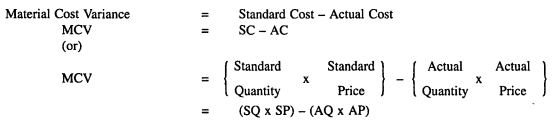
Direct Material Variances are also known as Material Cost Variances. The Material Cost Variance is the difference between the Standard cost of materials for the Actual Output and the Actual Cost of materials used for producing actual output. The Material Cost Variance is computed as:

Direct Material Variance

(1) Material Price Variance (MPV) : MPV is the difference between the standard cost of actual quantity and actual cost for actual quantity. 

MPV = (SP - AP) x AQ 

(2) Material Usage Variance (MUV) : MUV is the difference between the standard cost of standard quantity of material for actual output and the Standard cost of the actual material used. 

MUV = SP x (SQ - AQ) 

(3) Material Mix Variance (MMV) : It is the portion of the material usage variance which is due to the difference between the Standard and the actual composition of mix. Material Mix Variance is calculated under two situations as follows : 

(a) When Actual Weight and Standard Weight of Mix are equal : 

(i) The formula is used to calculate the Variance: 

MMV = SP x (SQ - AQ) 

(ii) In case standard quantity is revised due to shortage of a particular categoryof materials, the formula will be changed as follows : 

MMV = SP x (RSQ - AQ) 

Where, RSQ = Revised standard quantity 

(b) When Actual Weight and Standard Weight of Mix are different: 

(i) The formula used to calculate the Variance is : 

MMV = ( Total weight of actual mix/ Total weight of standard mix X standard cost of standard mix) - standard cost of actual mix 

(ii) In case the standard is revised due to the shortage of a particular category of materials, the alternative formula will be as follows: 

MMV = ( Total weight of actual mix/ Total weight of standard mix X standard cost of revised standard mix) - standard cost of actual mix 

(3) Materials Yield Variance (MYV) : It is the portion of Material Usage Variance. This variance arises due to spoilage, low quality of materials and defective production planning etc. Materials Yield Variance may be defined as "the difference between the Standard Yield Specified and the Actual Yield Obtained." This variance may be calculated as under: 

MYV = SR x ( AY - SY) 

Where, AY= Actual Yield, 

SY = Standard Yield and 

Standard Rate is calculated as follows : 

Standard Rate = Standard cost of standard mix / Net standard output. 

Verification: 

1. MCV = MPV + MUV 

2. MUV = MMV + MYV 

Notes- positive means favourable(F) and negative means adverse(A)

B. Labour Cost Variance: 

Labour Cost Variance is the difference between the Standard Cost of labour allowed for the actual output achieved and the actual wages paid. It is also termed as Direct Wage Variance or Wage Variance. Labour Cost Variance is calculated as follow:

Labour Cost Variance

1. Labour Cost Variance (LCV): Labour Cost Variance is the difference between the Standard Cost of labour allowed for the actual output achieved and the actual wages paid. 

Labour Cost Variance = Standard Cost of Labour - Actual Cost of Labour (or) Labour Cost Variance = {SR x SH for AO} - { AR x AH} 

Where, 

SR = Standard Rate, 

ST = Standard Hour, 

AO = Actual Output, 

AR = Actual Rate, 

AT = Actual Hour. 

2. Labour Rate Variance (LRV) : It is that part of labour cost variance which is due to the difference between the standard rate specified and the actual rate paid. This variances arise from the following reasons: 

(a) Change in wage rate. 

(b) Faulty recruitment. 

(c) Payment of overtime. 

(d) Employment of casual workers etc. 

It is expressed as follows : 

LRV = AH ( SR - AR) 

3. Labour Efficiency Variance (LEV) : Labour Efficiency Variance otherwise knownasLabour Time Variance. It is that portion of the Labour Cost Variance which arises duetothe difference between standard labour hours specified and the actual labour hours spent. The usual reasons for this variance are 

(a) poor supervision 

(b) poor working condition

(c) increase in labour turnover 

(d) defective materials. 

It may be calculated as following: 

LEV = SR ( SH - effective AH) 

4. Labour Idle Time Variance : Labour Idle Time Variance arises due to abnormal situations like strikes, lockout, breakdown of machinery etc. In other words, idle time occurs due to the difference between the time for which workers are paid and that which they actually expend upon production. 

It is calculated as follows : 

Idle Time Variance = Idle Hours x Standard Rate 

5. Labour Mix Variance (LMV) : It is otherwise known as Gang Composition Variance. This variance arises due to the differences between the actual gang composition than the standard gang composition. Labour Mix Variance is calculated in the same way of Materials Mix Variance. This variance is calculated in two ways: 

(i) When Standard and actual times of the labour mix are same: The formula for its computation may be as follows : 

LMV = Standard cost of standard labour mix - Standard cost of Actual labour mix. 

(ii) When Standard and actual times of the labour mix are different : Changes in the composition of a gang may arise due to shortage of a particular grade of labour. It may be calculated as follows : 

LMV = (RSH - AH) x SR Where, Revised Standard Hour (RSH) = Total Actual Hour/ Total standard hour X actual hour. 

6. Labour Yield Variance (LYV) : 'This variance is calculated in the same way as Material Yield Variance. Labour Yield Variance arises due to the variation in labour cost on account of increase or decrease in yield or output as compared to relative standard. The formula for this purpose is as follows: 

LYV = Standard labour cost per unit of output X (Standard output for actual hour - actual output) 

Verification: 

1. Labour Cost Variance = Labour Rate Variance + Labour Efficiency Variance 

2. Labour Efficiency Variance = Labour Mix Variance + Labour Yield Variance


C. Overhead variance : 

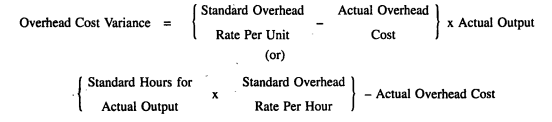
Overhead is explained as the cumulative of indirect material cost, indirect labour cost and indirect expenses. Overhead Variances may occur due to the difference between standard cost of overhead for actual production and the actual overhead cost incurred. The Overhead Cost Variance may be computed as follows:

Over Head Variance

Classification of Overhead Variance Overhead Variances can be classified as : 

A. Variable Overhead Variances: 

(1) Variable Overhead Cost Variance 

(2) Variable Overhead Expenditure Variance 

(3) Variable Overhead Efficiency Variance 

B. Fixed Overhead Variance: 

(a) Fixed Overhead Cost Variance 

(b) Fixed Overhead Expenditure Variance 

(c) Fixed Overhead Volume Variance 

(d) Fixed Overhead Capacity Variance 

(e) Fixed Overhead Efficiency Variance 

(f) Fixed Overhead Calendar Variance


Sales variance :  

The Variances so far analysis is linked to the cost of goods sold. Quantum of profit is derived from the difference between the cost and sales revenue. Cost Variances affect the amount of profit positively or unfavourably depending upon the cost from materials, labour and overheads. Additionally, it is important to analyse the difference between actual sales and the targeted sales because this difference will have a direct impact on the profit and sales. Therefore the analysis of sales variances is important to study profit variances.

Sales Variances can be calculated by two methods:

A. Sales Value Method.

B. Sales Margin or Profit Method.

Basis of Calculation: Variance analysis emphasizes the causes of the variation in income and expenses during a period compared to the financial plan. In order to make variances significant, the idea of 'flexed budget' is used when calculating variances. Flexed budget acts as a link between the original budget (fixed budget) and the actual results. Flexed budget is prepared in retrospect based on the actual output. Sales volume variance accounts for the difference between budgeted profit and the profit under a flexed budget. All remaining variances are calculated as the difference between actual results and the flexed budget.


To summarize, Variance Analysis, is administrative accounting which denotes to the analysis of deviations in financial performance from the standards definite in organizational budgets. In Variance Analysis, the difference between actual cost and its budgeted or standard cost segregated into price or quality component. It has been shown that favourable variance occurs when output exceeds input or when the price paid for the goods and services is less than anticipated. An unfavourable variance occurs when output is less than input or when the price for goods and services is greater than expected.


Standard Cost and Standard Costing : Meaning, Concept, Objectives, Advantages, Limitations

 Standard Cost and Standard Costing 

Meaning :

The word standard means a 'norm' or a 'criterion'. Standard cost is thus a criterion cost which may be used as a yardstick to measure the efficiency with which actual cost has been incurred.
There is a constant process of development effected in business through the help of standard costing method since the standard costs set in are sensible, capable of being attained and are revised from time to time in accord with needs and requirements of the business enterprise.


Standard Cost :

Standard cost is a figure which represents an amount that can be taken as a typical of the cost of an article or other cost factor. It is established on the basis of planed operations, planed cost efficiency levels, and expected capacity utilization.

Standard cost is a predetermined calculation of the presumed cost under the specified conditions. It is built up from an assessment of the value of cost elements. It correlates technical specification of material, labour and other cost to the price or wage rate which have occurred during the period in which the standard cost is to be determined.

The standard cost is a predetermined cost which is calculated from management standard of efficient operation and relevant necessary expenditure. - by C.I.M.A. London 

The standard cost is a predetermined cost which determines what each product or service should cost under given circumstances. - by Brown and Howard


Standard Costing:

A standard costing system is a method of cost accounting in which standard costs are used in recording certain transaction and the actual costs are compared with the standard cost to learn the amount and reason for variations from the standard. - by W.B. Lawrence 

Standard costing involves the preparation of cost based on pre‐ determined standards and continuous comparison of actual with them for the purpose of guidance and control. - by D. Joseph


Historical Costing:

The term ‘Historical Cost’ is also known as Actual Cost. The meaning of this cost suggests the actual costs of products which have been incurred in their production.

The experts maintain that, the production of products, the expenses like material, labour, overheads etc. should be paid first and then they should be recorded in books. So these total expenses are called historical costs or past costs.

The figures relating to costs obtained at the end of the production process may have some definite value in rectifying past practices if they are properly analyzed. 


Concepts of Standard Cost and Standard Costing:

1) Standard Cost:

standard costs are called pre-determined costs. The different standards regarding all the elements of costs, i.e., material, labor and overheads, are determined on the basis of historical cost and many other factors. These factors are cautiously studied before determining the standards. The standard committee will generally consist of production manager, purchase manager, personal manager, and other functional heads. It is possible that the standard cost decided by the manager could be idle, normal or expected. The idle standard cost may refer to an estimate of the cost under perfect competition. It is competed on the basis that there is no scrap, no idling of machinery or breakdown and so on. On the other hand, expected standard cost is based upon the attainable result.

Standard Costs are not simple average but they are set with due care after careful study and observation of production activity in the past and the present.

2) Standard Costing:

Standard costing is a perfect system of controlling the costs and measuring efficiency and its development. It is a technique of cost reduction and cost control. It helps to provide valuable guidance in several management functions such as formulating policies, determining price level, etc. The essence of standard costing is to set objectives and targets to achieve them, to compare the actual costs with these targets.

Standard Costing is used to ascertain the standard cost under each element of cost, i.e., materials, labours, overhead. It can eliminate all kinds of waste. Through the application of this costing it can be ascertained whether or not the activities of production are going on according as the pre-determined plan. 


Objectives of Standard Costing:

  1. To institute a control mechanism on all the elements of costs that affect production and sales

  2. To measure different operational efficiencies and check the wastages

  3. To improve the delegation of authority and generate a sense of

    responsibility among the employees

  4. To develop a cost consciousness in the employees

  5. To presume the production costs, sales and profit

  6. To avail the benefits of 'Management by exception.'

  7. To bring about a vivid progressive vision and sagacious decision making at

    each managerial level. 


Advantages of Standard Costing:

1. Proper Planning: It helps to apply the principle of “Management by exception”. That is, the management need not worry over those activities which proceed in tandem plans. It is only on the issues of exceptions that they have to concentrate.

2. Efficient Cost Control: Standard Costing is a tool for the management to gain reduction in the cost and control over it. Under this technique, differences are analyzed and responsibilities are determined.

3. Motivational Factor: Labour efficiency is promoted and they are destined to be cost conscious. Standards provide incentives and motivation to work with greater effort. This increases efficiency and productivity.

4. Comparison of Forecasting and Outcome: A target of efficiency is set for the employees and the cost consciousness is stimulated. Since the process of standard costing allow an appraisal to be made of personnel, machines and method of working, current inefficiencies come to the notice and get eliminated.

5. Inventory Control: Standard costing facilitates inventory control and simplifies inventory valuations. This ensures uniform pricing of stocks in the form of raw materials, work-in-progress and finished goods.

6. Economical System: Standard costing system is economical system from the viewpoint that it does not require detailed records. It also does not require a big staff. It results in the reduction in paper work in accounting and needs very few records. Thus, there is saving of time as well as money.

7. Helpful in Budgeting: Budgets are prepared on the basis of standard costing. Standards which are set up in respect of materials, labour and overheads, are helpful in preparing various budgets. For example, flexible budget, sales budget, etc.

8. Helps Formulate Policies: This technique is a valuable aid to the management in determining prices and formulating production policies. Standard costing equips cost estimates while planning the production of new products.

9. Helps Distinguish Activities: Standard costing helps in distinguishing between skilled and unskilled activities. So the skilled worker only gives pays attention to improving the activities of the unskilled workers.

10. Eliminates Wastage: Through fixing standard, certain waste such as material wastage, idle time, lost machine hours, etc. are reduced.


Limitations of Standard Costing:

  1. Costly System: Because the Standard Costing requires highly skilful and competent personnel, it becomes a costly system too. For the same experts are paid high remuneration.

  2. Difficulties in Fixation of Standard: It is always difficult to determine precise standard costs in a given situation which will coincide with actual cost when operations are over. Standard cost are determined partly by the past experience and partly by the cost projections based on advanced statistical techniques. Thus, uncertainties revolve around standards.

  3. Constraint for Service Industry: Standard costing is applied for planning and controlling manufacturing costs. Thus, it cannot be applied in a service industry.

  4. Consistency of Standard: because the standards of marginal costing fluctuate and vary time to time, it is difficult to always sustain and continue the same standards.

  5. Unsuitable for Non-standardised Products: Standard costing is expensive and unsuitable for job manufacturing industries as they manufacture non standardized products such as catering, tailoring, printing, etc.

  6. Relatively Fixed Standards: A business may not be able to keep standards up-to-date. In other words, a business may not revise standards to keep pace with the frequent changes in manufacturing conditions. Firms may avoid revising standards as it is a costly affair.

  7. Difficulties for Small Industries: Establishment of standards and their implementation involve initial high costs. Standards have to be revised and new standards be fixed involving larger costs. Thus, small firms find it expensive to operate standard costing system. This system is not fit for each type of industries.

  8.  Discouragement for Workers: Sometimes the employees and workers are discouraged when the standards are fixed at a high level. The unreal high standards may adverse by effect the morale of workers rather than working as an incentive for better efficiency.

  9. Inaccurate Diverse Results: Inaccurate and unreliable standards cause misleading results and thus may not enjoy the confidence of the users of this system. 

Friday, April 15, 2022

Capital Budgeting : Meaning, Objectives, Features, Principles

Capital Budgeting


What is Capital Budgeting?

Capital budgeting is a process of evaluating investments and huge expenses in order to obtain the best returns on investment. An organization is often faced with the challenges of selecting between two projects/investments or the buy vs replace decision. Ideally, an organization would like to invest in all profitable projects but due to the limitation on the availability of capital an organization has to choose between different projects/investments. Capital budgeting as a concept affects our daily lives. 


Let’s look at an example-

Your mobile phone has stopped working! Now, you have two choices: Either buy a new one or get the same mobile repaired. Here, you may conclude that the costs of repairing the mobile increases the life of the phone. However, there could be a possibility that the cost to buy a new cell phone would be lesser than its repair costs. So, you decide to replace your cell phone and you proceed to look at different phones that fit your budget!


What are the objectives of Capital budgeting?

Capital expenditures are huge and have a long-term effect. Therefore, while performing a capital budgeting analysis an organization must keep the following objectives in mind:

1. Selecting  profitable projects

An organization comes across various profitable projects frequently. But due to capital restrictions, an organization needs to select the right mix of profitable projects that will increase its shareholders’ wealth.  


2. Capital expenditure control

Selecting the most profitable investment is the main objective of capital budgeting. However, controlling capital costs is also an important objective. Forecasting capital expenditure requirements and budgeting for it, and ensuring no investment opportunities are lost is the crux of budgeting.  


3. Finding the right sources for  funds

Determining the quantum of funds and the sources for procuring them is another important objective of capital budgeting. Finding the balance between the cost of borrowing and returns on investment is an important goal of Capital Budgeting.  


The following are some other objectives of capital budgeting.

1. To find out the profitable capital expenditure.

2. To know whether the replacement of any existing fixed assets gives more return than earlier.

3. To decide whether a specified project is to be selected or not.

4. To find out the quantum of finance required for the capital expenditure.

5. To assess the various sources of finance for capital expenditure.

6. To evaluate the merits of each proposal to decide which project is best.


Features of Capital Budgeting


The features of capital budgeting are briefly explained below:

1. Capital budgeting involves the investment of funds currently for getting benefits in the future.

2. Generally, the future benefits are spread over several years.

3. The long term investment is fixed.

4. The investments made in the project is determining the financial condition of business organization in future.

5. Each project involves huge amount of funds.

6. Capital expenditure decisions are irreversible.

7. The profitability of the business concern is based on the quantum of investments made in the project.


Principles of Capital Budgeting

Capital budgeting has five principles that play a crucial role in the allocation of money and the process of capital budgeting. The five principles are; 

(1) decisions are based on cash flows, not accounting income, 

 Relevant cash flows are based on incremental cash flows.  This represents the changes in cash flow if the project is undertaken.  Aspects of cash flow that affect capital budgeting are sunk costs and externalities.  These are both costs that cannot be avoided.  Sunk costs are costs that are unavoidable, even if the project is undertaken.  Externalities are side effects of a project that affect other firm cash flows.


(2) cash flows are based on opportunity cost, 

Cash flows are based on opportunity cost.  In other words, it is the cash flow that will be lost due to the financing of a project. These are cash flows that are accumulated by assets the firm already owns and would be sunk if the project under consideration is undertaken.


(3) The timing of cash flows are important, 

The timing of cash flow is crucial because it is dependent on the time value of money.  Cash flow that is received now will be worth more in the future if it were to be received later.


(4) cash flows are analyzed on an after tax basis, 

Cash flows are measured on an after tax basis.  It is useless to measure cash flow before taxes because it is not its present value.  Firm’s value is based on cash flow that a firm gets to keep, not the money that is sent to the government.


(5) financing costs are reflected on project’s required rate of return.

Financing costs are reflected on project’s required rate of return.  Rate of return is an aspect of financing that has potential risks.  Project’s that are expected to have a higher rate of return than their cost of capital will increase the value of the firm. 

Structure of Indian Banking System

  Structure of Indian Banking System :  Structure of Indian banking system can be described as follows : The Indian Banking System is classi...